


If you regularly deal with bloating, digestive discomfort, reflux, constipation or an unsettled stomach, you probably know how frustrating it can be to find something that actually helps. Maybe you've tried probiotics. Maybe you've added digestive supplements to your routine, swapped your coffee for herbal tea or started avoiding certain foods. You might feel better for a while, only for the same symptoms to come back again.
It can leave you wondering why your gut still isn't happy when you're doing everything you're supposed to be doing.
One reason may be that gut health is about more than simply adding more bacteria. Your gut microbiome is an entire ecosystem, and the environment those bacteria live in matters too. The food you eat can influence that environment, including the compounds available to your gut bacteria and the way your digestive system responds to them.
Why Isn't Taking Probiotics Always Enough?
Probiotics have become one of the most popular ways to support gut health, and there is plenty of interest in the relationship between beneficial bacteria and the digestive system. But taking a probiotic is only one part of the picture.
Think about your gut like a garden. Adding new plants doesn't necessarily mean they are going to thrive. They also need the right soil, nutrients, water and environment to grow. Your gut bacteria are similar. Simply introducing beneficial bacteria does not tell us what will happen to them once they reach your digestive system. The food you eat also provides compounds that can influence the environment in which your gut microbiome exists.
That is why prebiotics are so important. While probiotics provide live microorganisms, prebiotics are substances that can be used by beneficial microorganisms in the gut. Rather than only asking, "What good bacteria can I add?", it is worth asking, "What can I give my gut bacteria to help support a healthy environment?"
How Can Jarrah Honey Support Your Gut Microbiome?
Jarrah honey contains naturally occurring compounds that have attracted interest for their potential prebiotic effects. Research into Australian Jarrah honey has investigated its influence on gut bacteria and short-chain fatty acids, including butyrate. Butyrate is produced by certain gut bacteria when they ferment dietary compounds, and it is an important energy source for the cells lining the colon.
This is one of the reasons researchers are interested in the relationship between honey, gut bacteria and digestive health. Rather than thinking of honey simply as a sweetener, it can also be viewed as a food containing a range of naturally occurring compounds that interact with the digestive system.
Jarrah honey also contains naturally occurring oligosaccharides and other compounds that may have prebiotic potential. These compounds can interact with the gut microbiome and support the growth or activity of certain beneficial bacteria. It is an emerging area of research, but it adds another dimension to the conversation around what makes different types of honey nutritionally unique.
Could Jarrah Honey Help Support a Healthy Gut Environment?
Your digestive tract has a delicate balance to maintain. The gut lining acts as an important barrier between the contents of your digestive system and the rest of your body, while the mucus layer provides another important layer of protection.
The food you eat can contribute to the health of this environment. Foods rich in naturally occurring antioxidants and plant compounds are particularly interesting because they can help support the body's natural defences against oxidative stress.
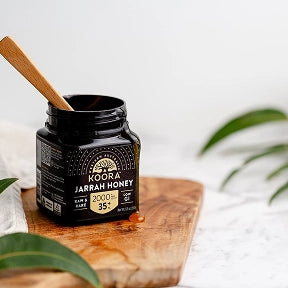
Jarrah honey contains a variety of phenolic compounds and flavonoids, which contribute to its antioxidant activity. These compounds are part of what gives different honeys their distinctive properties, and the amounts can vary significantly depending on the floral source. Jarrah honey is particularly interesting because of its naturally high level of bioactive compounds. KOORA Jarrah Honey TA35+ is certified for high Total Activity, which reflects its naturally occurring antimicrobial activity.
This combination of antioxidant and bioactive properties is one of the reasons Jarrah honey is attracting interest as more than just a natural sweetener.
What Makes Jarrah Honey's Antimicrobial Activity Different?
One of the most distinctive characteristics of high-activity honey is its natural antimicrobial activity. Honey can contain several different mechanisms that contribute to this activity, including the production of hydrogen peroxide when honey is diluted. The level of activity varies between different honeys, which is why the source and quality of the honey matter.
KOORA Jarrah Honey TA35+ is certified at TA35+, indicating a very high level of Total Activity.
Laboratory research into high-activity Australian honeys has explored their natural antimicrobial properties and activity against various microorganisms in preliminary studies. While Jarrah honey is a natural food product and not a medicine or replacement for medical treatments, its certified Total Activity (TA) reflects these inherent natural properties.
Studies have also investigated honey's activity against a range of microorganisms, including Helicobacter pylori, commonly known as H. pylori. H. pylori is a bacterium associated with conditions including gastritis and peptic ulcers, and it is an important area of gastrointestinal research.
However, it is important to make a distinction here. Honey is not a replacement for medical treatment for H. pylori infection, ulcers, reflux or other gastrointestinal conditions. If you have persistent or severe digestive symptoms, getting an appropriate diagnosis and treatment from a healthcare professional is important.
What makes the research interesting is that it demonstrates how much more complex honey can be than its sweetness alone suggests.
Why Does Jarrah Honey's Low GI Matter for Digestion?
Another distinctive feature of Jarrah honey is its naturally low glycemic index. The glycemic index measures how quickly carbohydrate-containing foods raise blood glucose levels. Foods with a lower GI are generally absorbed more gradually, resulting in a slower rise in blood glucose compared with higher-GI foods.
This matters because the way your body responds to different carbohydrates can vary considerably. For people who are mindful of blood glucose or simply want to choose foods with a lower glycemic impact, Jarrah honey can offer an alternative to conventional sweeteners.
There is also growing interest in the relationship between diet, blood glucose and digestive symptoms. However, it is too simplistic to say that low-GI foods will automatically prevent bloating, IBS symptoms or digestive discomfort. Gut health is highly individual, and people can respond very differently to the same foods.
What we can say is that Jarrah honey has a naturally low glycemic index compared to many conventional sweeteners. This offers a steady energy release without the rapid blood glucose spikes associated with high-GI sugars.
So, What Makes KOORA Jarrah Honey Different?
When you put all of these characteristics together, you start to understand why Jarrah honey is so interesting.
KOORA Jarrah Honey TA35+ isn't simply chosen for its taste. It is a raw, traceable Western Australian honey with certified high Total Activity and a naturally occurring combination of bioactive compounds, antioxidants and prebiotic components.
Its potential prebiotic activity gives researchers a reason to investigate its relationship with the gut microbiome. Its antioxidant compounds contribute to its ability to help protect against oxidative stress. Its naturally occurring antimicrobial activity makes high-TA Jarrah honey particularly distinctive, while its low glycemic index sets it apart from many conventional sweeteners.
These properties don't exist separately in a capsule. They naturally occur together within the whole food, and that's what makes the wholefood approach so interesting.
Can Jarrah Honey Be Part of Your Everyday Gut Health Routine?
Supporting your digestive health doesn't have to mean completely overhauling your life. Your gut is influenced by your overall diet, sleep, stress, physical activity and many other factors. No single food can replace all of those things, but small, consistent choices can become part of a healthy routine.
KOORA Jarrah Honey TA35+ can be enjoyed straight from the spoon, stirred into warm water or added to a caffeine-free herbal tea. You can also use it as a natural sweetener in breakfast foods or snacks. If you are introducing a new food into your diet, start with a small amount and pay attention to how your body responds. This is particularly important if you already know that certain foods trigger digestive symptoms for you.
The goal isn't to find one food that fixes everything. It's to build a diet that gives your body a variety of nutrients and naturally occurring compounds that support overall health.
What Are Customers Saying About Jarrah Honey and Digestion?

Of course, everyone's digestive system is different. What works well for one person won't necessarily produce the same experience for someone else. We love hearing how customers incorporate KOORA into their everyday routines, particularly when it becomes a simple alternative to the products they've tried before.
One customer, April, shared:
"I tend to have acid indigestion... only with KOORA's Jarrah honey does my tea actually control it."
Personal experiences like this are encouraging, but they are just that: individual experiences. They don't mean Jarrah honey will treat or prevent reflux or other digestive conditions for everyone. What they do show is how customers are finding their own ways to incorporate Jarrah honey into their daily routines.
Could Your Gut Need More Than Just Probiotics?
Gut health is rarely as simple as adding one thing and taking another thing away. Your digestive system is home to a complex community of microorganisms, and supporting that community involves more than simply adding probiotic bacteria. The food you eat helps shape the environment in which your gut microbiome exists, while naturally occurring compounds in foods can interact with your digestive system in different ways.
Jarrah honey offers an interesting example of this wholefood approach. From its potential prebiotic effects and naturally occurring antioxidant compounds to its certified high Total Activity and low glycemic index, KOORA Jarrah Honey TA35+ has a combination of properties that makes it very different from ordinary honey.
It isn't a replacement for medical treatment, and it isn't a miracle cure for digestive problems, but as part of a balanced diet and healthy lifestyle, it is a fascinating wholefood with a growing body of research behind it.
So, rather than thinking about gut health as simply adding another supplement to your routine, start by looking at the bigger picture.
Feed your gut. Support your body. Keep it simple, and when you want to add something naturally sweet to your day, make it raw, rare and Western Australian.
Discover KOORA Jarrah Honey TA35+ and experience the unique properties of one of Western Australia's most distinctive honeys.
Scientific References
-
Mohan, A., et al. (2017). Effect of Honey in Improving the Gut Microbiome and Digestive Health. Nutrients, 9(8), 843. https://www.ncbi.nlm.nih.gov/pmc/articles/PMC5549483/
-
Mandal, M. D., & Mandal, S. (2011). Honey: its medicinal property and antibacterial activity. Asian Pacific Journal of Tropical Biomedicine, 1(2), 154–160. https://www.ncbi.nlm.nih.gov/pmc/articles/PMC6613697/
-
Robert, S. D., et al. (2011). Glycemic index assessment of natural honeys. International Journal of Food Sciences and Nutrition, 62(5), 478–481. https://www.ncbi.nlm.nih.gov/pmc/articles/PMC3210003/