

Supermarket Honey vs KOORA Honey — What’s Actually Different?
At a glance, most honey looks the same. It’s golden, thick, and labelled with words like “pure,” “raw,” and “natural.” But what those labels don’t show is how differently these products can behave in your body, because when it comes to honey, the real difference isn’t just taste, it’s whether the honey still contains the compounds that give it functional value.
The Problem with Honey Labels
Why “Natural” Doesn’t Mean What You Think
In the supermarket aisle, honey is marketed to appear simple and wholesome. However, terms like “natural” and “pure” are not tightly regulated indicators of quality. They don’t tell you where the honey comes from, how it’s been processed, or whether it still contains enzymes, antioxidants, and other bioactive compounds. This creates an illusion of sameness, where very different products are presented as if they are equal.
The Bigger Issue: Honey Fraud and Adulteration
One Of The Most Commonly Adulterated Foods
Beyond processing, honey is also one of the most commonly adulterated foods globally. Food fraud researchers and regulatory bodies have consistently identified honey as a high-risk product for economically motivated adulteration — where cheaper ingredients are added or quality is reduced to increase profit margins.
A 2023 investigation by the European Commission found that nearly half of tested honey imports were suspected of being adulterated or non-compliant with authenticity standards (Joint Research Centre, 2023). Similarly, the U.S. Food and Drug Administration has identified cases of honey containing undeclared sweeteners such as rice syrup and cane sugar.
This doesn’t mean all supermarket honey is fake, but it highlights how common dilution, blending, and misrepresentation can be within the category.
How Honey Is Altered
Adulteration is not always obvious. In many cases, honey is diluted with lower-cost sweeteners or processed in ways that make tracing its origin difficult. Ultra-filtration can remove pollen, while blending combines multiple sources into a single product with no clear origin. Common practices include:
- Adding cheap sugar syrups (rice, wheat, beet, or corn-based)
- Blending honey from multiple unknown sources
- Ultra-processing through high heat and over-filtration to remove pollen and hide origin
In many cases, these changes are not disclosed on the label. Additionally, because modern syrups can closely mimic honey’s chemical profile, fraud is increasingly difficult to detect, even with traditional testing methods.
What’s Actually in Supermarket Honey
Processing Vs Functional Value
Most supermarket honey undergoes blending, pasteurization, and filtration. While these processes improve shelf life and consistency, they also reduce many of the compounds that give honey its functional properties.
Research published in the Journal of Food Science has shown that heating honey can significantly reduce enzyme activity and antioxidant levels. As a result, the final product may still taste like honey, but its nutritional complexity is reduced to just sugars. Without these compounds, it behaves more like a simple carbohydrate source.
Why Processing Makes a Different Product
Heat processing can degrade these compounds, reducing efficacy of their functional effects — even if the honey still looks and tastes the same.
What Makes KOORA Honey Different

Raw, Unprocessed, Pure with Measurable Activity
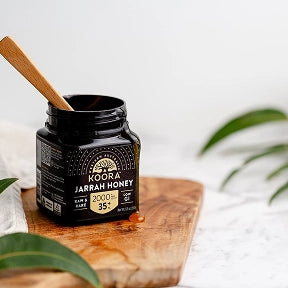
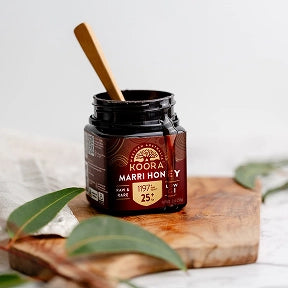
KOORA honey, sourced from the pristine Jarrah and Marri forests in Western Australia, is raw and unprocessed. It is not pasteurized or heavily filtered, allowing it to retain its natural benefits.
These forests are among the most remote and ecologically protected in the world, with vast areas of native bushland that are largely untouched by industrial agriculture. This isolation matters — because it significantly reduces exposure to environmental contaminants such as glyphosate, that are more common in intensively farmed regions.
This means that KOORA’s Jarrah TA35+ and Marri TA25+ honeys, which are also independently tested to be glyphosate-free, are not contaminated with residues of this widely used herbicide. In a global food system where trace chemical exposure is increasingly scrutinised, KOORA's single origin provides a source of incomparable purity and quality.
Unlike many global honey sources, Western Australia maintains some of the strictest biosecurity controls, helping preserve the purity of its ecosystems. As a result, the nectar collected by bees in these regions comes from clean floral sources, rather than monoculture crops or chemically treated farmland.
Importantly, the honey is not pasteurised or heavily filtered. This allows it to retain its natural composition — including enzymes, antioxidants, and other bioactive compounds — while also preserving its traceability back to a single, well-defined origin.
A key point of difference is that every batch is lab-tested for Total Activity (TA), a measurable indicator of antimicrobial strength. Unlike general marketing terms, TA reflects actual antimicrobial biological activity.
Because it is not exposed to high heat, KOORA honey retains enzymes, antioxidants, and prebiotic compounds — elements associated with supporting microbial balance and overall health.
The Role of KOORA Honey in Sleep and Recovery
The Gut–Brain Connection
There is growing scientific interest in the relationship between gut health and the nervous system. Research published in journals such as Nature Reviews Gastroenterology & Hepatology highlights how gut microbiota can influence processes including sleep (Mayer et al., 2015). While honey is not a direct sleep treatment, raw honey that retains its natural compounds may support a more balanced internal environment, contributing to a calmer state when used consistently as part of a nighttime routine.
One of the key pathways involved in sleep regulation is the amino acid tryptophan, which is a catalyst to serotonin and ultimately melatonin — the hormone responsible for regulating sleep-wake cycles. When the body has the right conditions to support this pathway, it can contribute to a more natural and balanced sleep and recovery process.
Raw KOORA honey contains small amounts of naturally occurring compounds that may support this pathway indirectly, particularly when consumed as part of a calming evening routine. While honey itself is not a direct source of melatonin, its role lies in supporting the broader metabolic environment that influences how efficiently these pathways function.
The Blood Sugar Difference
Not All Honey Is Metabolically The Same
Another key factor is glycemic index (GI), which measures how quickly a food raises blood sugar levels. Foods with a glycemic index of 55 or below are low GI, meaning they are digested and absorbed slowly, resulting in a gradual, steady rise in blood sugar. Medium (56 to 69) and high (70 to 100) GI are digested more quickly, causing rapid spikes and crashes in blood sugar.
Many commercial honeys fall within the GI range of 60-80, similar to refined sugar.
However, rare varieties such as Jarrah honey have a uniquely low GI. Unlike other higher GI honeys, including Manuka, Jarrah honey’s low GI provides more stable energy levels, fewer spikes and crashes, and a more balanced metabolic response over time.
Why Choose Low GI?
- Stable Energy: Prevents the energy crashes and fatigue caused by blood sugar spikes.
- Appetite Control: Because they digest slowly, these foods keep you feeling fuller for longer.
- Health Management: Low GI diets are highly recommended for managing type 2 diabetes, heart health, and weight loss.
The Real Difference
At a surface level, all honey may look similar. But differences in sourcing, processing, measurable antimicrobial activity, and glycemic index create entirely different products.
One is processed to mass produce an unhealthy cheap syrup labeled honey. The other preserves the pure, raw potency of a unique honey with unmatched bioactive functional properties.
What to Look for on Honey Labels
How To Choose Better and Real Honey
When reading honey labels, focus on what actually indicates quality. Look for products that contain 100% honey with no added syrups, are raw or minimally processed, and provide transparency around origin. Look for measurable indicators like Total Activity (TA), rather than relying on marketing language. However one might note that in the case of food fraud, the labels will no longer make any difference. So looking for a reputable source with traceability is going to make all the difference.
A cheap price point does also mean it might not be real honey. It is sustainably unachievable for real honey with sustainable beekeeping practices to be priced cheaply. In fact, low unsustainable prices destroy the real honey market. So please support real beekeepers by purchasing real honey from reputable sources like KOORA.

Final Thought: Invest in Real, Functional Wellness
If you’re choosing honey purely for sweetness, most options will seem interchangeable. And the honest truth is refined sugar is cheaper.
But if you’re choosing honey for what it can offer beyond taste — for its living enzymes, rich antioxidants, and independent lab-tested antimicrobial power — the differences become impossible to ignore. Once you understand the reality of global food fraud and heavy factory processing, the massive gap between dead supermarket honey and true functional honey becomes glaringly clear.
Real honey isn't just a sweetener; it is an active investment in your health, providing benefits for immunity support, gut and digestive health, inflammation, better sleep and recovery, healthy low GI energy and sweetness.
Don't let vague labels trick you into buying ultra-processed, cheap honey that is sugar syrup stripped of its value.
🍯 Choose Purity. Experience the KOORA Difference.
Don't gamble with your wellness. Skip the supermarket red flags and treat your body to 100% raw, traceable, and biologically active honey sourced from pristine, protected Western Australian forests.